Your payslip is the one page that shows what you earned, what came off and what reached your bank account. If the lines do not add up, you can ask payroll, and this guide shows you what to ask. It walks through one sample monthly payslip from gross pay to the deposit, and it separates the deductions that lower your tax from the ones that do not.
Every amount below is made up for the example, so it is not your pay. The tax and contribution rates are the 2026/27 rates, and your employer's payroll method decides the exact result on your own payslip.
A payslip starts with your gross pay, takes off retirement fund, medical aid, UIF and PAYE, and ends with the net pay paid into your bank account. In the sample below, R32,500 gross becomes R22,878.88 net. Your employer's own costs, such as its UIF share and the skills development levy, sit outside that sum. Check that gross pay less every deduction equals the amount paid.
Also useful from PayTools
What a payslip must show
Section 33 of the Basic Conditions of Employment Act (BCEA) says your employer must give you written pay information each time you are paid. It must show the employer's name and address, your name and occupation, the period the pay covers, your remuneration in money, the amount and purpose of every deduction and the amount actually paid to you. Where it applies to your pay, it must also show your rate of pay and overtime rate and the ordinary, overtime, Sunday and public holiday hours you worked.
Two limits apply. Chapter Four of the Act, which holds section 33, does not cover an employee who works less than 24 hours a month for an employer (section 28(1)). And an employer with fewer than five employees does not have to give the section 33 pay information (section 28(2)).
The section does not list PAYE, UIF or any tax figure, but most payslips show them because you need them to check the pay. Our take-home pay guide shows how those figures are built from a salary, and this guide starts from the payslip you already hold.
The sample payslip
Here is the fictional employee behind the table. Change one of these assumptions and the figures change with it.
- Employer: Sample Employer (Pty) Ltd, Durban. Employee: A. Sample, office administrator, paid monthly for 1 to 31 October 2026.
- Basic salary R30,000 a month, plus 10 hours of overtime at an agreed R250 an hour.
- Retirement fund: you pay 7.5% of your basic salary, R2,250 a month.
- Medical aid: you and one dependant, with your share of the premium at R3,200 a month. The employer pays none of it.
- No loans, no garnishee order, no allowances and no other benefits. UIF and PAYE are worked out on the 2026/27 tables.
The diagram shows the same payslip laid out as a typical payslip, with an arrow from each part to what it means. The table after it gives every amount.
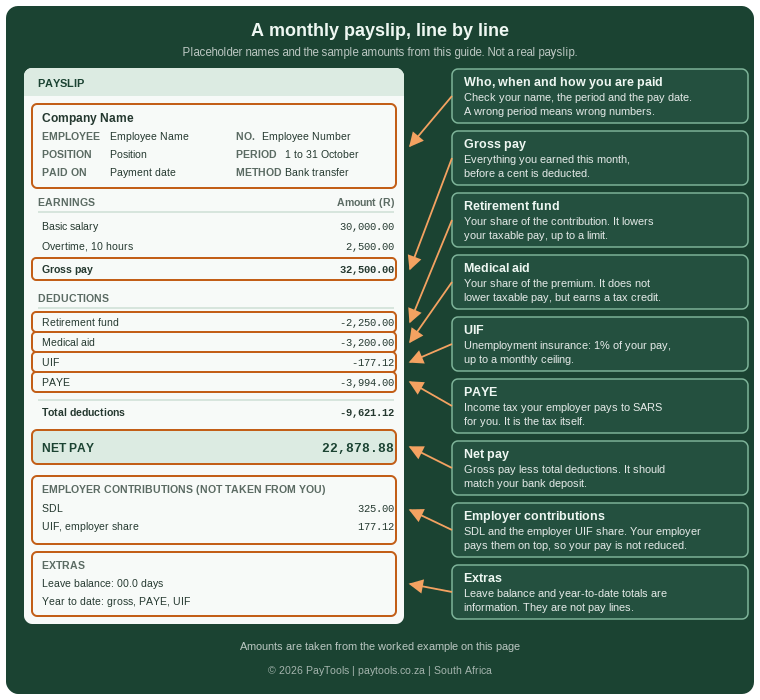
| Line | Amount (R) | Lowers your taxable pay? |
|---|---|---|
| 1. Basic salary | 30,000.00 | Part of taxable pay |
| 2. Overtime, 10 hours at R250 | 2,500.00 | Part of taxable pay |
| 3. Gross pay | 32,500.00 | Not applicable |
| 4. Retirement fund, your share | -2,250.00 | Yes, up to a limit |
| 5. Medical aid, your share | -3,200.00 | No, but a tax credit applies |
| 6. UIF, your share | -177.12 | No |
| 7. PAYE | -3,994.00 | This is the tax itself |
| 8. Total deductions | -9,621.12 | Not applicable |
| 9. Net pay, paid into your bank account | 22,878.88 | Not applicable |
The notes below follow the line numbers. Work through them once with the table open and the same method will read your own payslip.
- Basic salary. This is your agreed monthly pay before anything comes off. Check that it matches your contract or your last salary letter.
- Overtime. 10 hours at R250 is R2,500.00. Overtime is part of your remuneration, so it counts towards PAYE and UIF. Your payslip should show the hours and the rate (section 33), so you can multiply them yourself.
- Gross pay. R30,000.00 + R2,500.00 = R32,500.00. Every percentage deduction starts from this figure or from a part of it, which is why it is the first line to get right.
- Retirement fund. 7.5% of R30,000 is R2,250.00. It comes off your pay in cash, and it also lowers the pay SARS taxes, up to the section 11F limit: the lesser of R430,000 a year, 27.5% of the greater of your remuneration or taxable income, and your taxable income. The R430,000 cap was announced in Budget 2026, legislation pending. R27,000 a year is well inside that limit.
- Medical aid. The R3,200.00 premium comes off your pay, but it does not lower your taxable pay. You get a medical scheme fees tax credit instead: R376 a month for you and R376 for your first dependant, R752 in all, which cuts the tax directly. Without that credit, the PAYE line would be higher.
- UIF. You pay 1% of your remuneration up to a ceiling of R17,712 a month, so the most that can come off is R177.12. At R32,500 the sample is above the ceiling, so the line is R177.12. Commission is left out of UIF remuneration.
- PAYE. The working is in the next section, because it is the line most people cannot check by eye.
- Total deductions. R2,250.00 + R3,200.00 + R177.12 + R3,994.00 = R9,621.12.
- Net pay. R32,500.00 - R9,621.12 = R22,878.88. This is the amount that should reach your account, and it is the figure to match against your bank statement.
How the PAYE line is worked out
Many payroll systems work PAYE out by annualising: they treat the month's taxable pay as one twelfth of a year, apply the tax table, subtract the rebate and credits, and divide by twelve. Here is that method for the sample, using the 2026/27 tax year (1 March 2026 to 28 February 2027).
- Taxable pay for the month: R32,500.00 gross less the R2,250.00 retirement contribution is R30,250.00. The medical premium is not taken off.
- Annual equivalent: R30,250.00 × 12 = R363,000.
- Tax on R363,000: that sits in the 26% band, which is R44,118 plus 26% of everything above R245,100. R363,000 - R245,100 = R117,900, and 26% of that is R30,654, so the tax is R74,772.
- Less the primary rebate of R17,820: R74,772 - R17,820 = R56,952.
- Less the medical credits for the year: R752 × 12 = R9,024, which leaves R47,928.
- Monthly PAYE: R47,928 ÷ 12 = R3,994.00.
Overtime is variable pay, and payroll systems treat variable pay in different ways, so your own PAYE line can differ from this working even when every other line matches. A gap is a question to ask payroll, not proof of an error. You can run your own figures through the PAYE calculator for a second estimate, and our PAYE guide explains the tax itself.
Cash out of your pocket versus tax
The last column of the payslip table is the one most people miss. Two deductions can leave your pay by the same amount and still have very different effects on your tax.
| Deduction | Comes off your pay | Effect on your PAYE |
|---|---|---|
| Retirement fund | Yes | Lowers your taxable pay, up to the section 11F limit |
| Medical aid | Yes | Does not lower taxable pay, but a monthly tax credit lowers the tax |
| UIF | Yes | None. Our reading is that section 23(m) of the Income Tax Act gives an employee no deduction for it |
| PAYE | Yes | It is the tax |
This is why a bigger retirement contribution can leave you with less cash than you expected and still cost you less than the full amount: part of it comes back as lower PAYE. If your employer also pays into your retirement fund or medical scheme, those payments are normally taxable benefits and can change your PAYE line, so the sample leaves them out.
What your employer pays on top
Some costs belong to the employer and are never taken from your pay. They may appear on your payslip as employer contributions, or not at all, and they are not part of your net pay sum.
| Line | Amount (R) | How it is worked out |
|---|---|---|
| UIF, employer share | 177.12 | 1% of remuneration, capped at the same ceiling |
| Skills development levy (SDL) | 325.00 | 1% of R32,500 total pay |
The employer's UIF share matches yours. The levy is 1% of the total payroll, and an employer whose total remuneration over the next 12 months will be R500,000 or less does not have to pay it. The sample assumes this employer is above that line. Add both amounts to the R32,500 and the cost of this employee for the month is R33,002.12, before any benefits. Our payroll cost calculator works that total out for your own figures.
Five checks on your own payslip
You do not need to redo the payroll to catch most mistakes. Five quick checks cover the usual ones.
- Does gross pay less the total deductions equal the amount paid to you, and does that amount match your bank statement?
- Is the UIF line 1% of your gross pay, or R177.12 if your pay is above the ceiling?
- Do the retirement and medical aid lines match what your contract or scheme says you pay?
- Does the PAYE line sit close to what the PAYE calculator gives for the same pay?
- Does every other deduction have a name, an amount and a written basis?
The last check is a legal one. Under section 34(1) of the BCEA, an employer may not deduct from your pay unless you agreed in writing to a specified debt, or a law, collective agreement, court order or arbitration award requires or permits it. A deduction you do not recognise needs a document behind it. A court order to pay a creditor from your salary has its own rules, which our garnishee order guide explains.
Reading the extras: leave, year to date and codes
Many payslips add information that is not a pay line. A leave balance shows the days you have left. Year-to-date totals add up your gross pay, PAYE and UIF since the start of the tax year, and they are what ends up on your IRP5. Payroll software may also show SARS income and deduction codes next to each line. Those four-digit codes tell SARS what each amount is, and our payslip codes guide explains them.
The extras can all hold mistakes, so give them the same attention as the pay lines. A leave balance that drops by more days than you took, or year-to-date figures that do not grow by about the same amount each month, are worth a question.
Why your payslip changes from month to month
Your net pay is not the same every month, even on a fixed salary, and the payslip shows why. A month with overtime has a higher gross pay and so a higher PAYE line, because the extra pay is taxed at the top of your bracket. A month with less overtime does the opposite. In the sample, the R2,500 of overtime adds R650 to the PAYE line, which is 26% of it, so net pay rises by R1,850 and not by R2,500. UIF does not change, because the basic salary alone is already above the ceiling.
A bonus works differently. SARS taxes an annual bonus as an annual payment, reported under code 3605: the PAYE on it is the tax on your annual pay plus the bonus, less the tax on your annual pay alone. Our bonus tax guide works through the method with figures. If a bonus month looks heavily taxed, check that the bonus is shown as its own line and not blended into your basic salary.
Changes to your retirement or medical aid contributions also move the PAYE line, and a new tax year changes the tables. A payslip after 1 March can show a different PAYE amount on the same salary, because the brackets, rebates and credits move each tax year.
When the numbers do not match
Start with the plain arithmetic, and only then ask payroll. Send one email, ask for explanations rather than a different number, and keep the reply.
- Please explain how my PAYE was worked out this month, including my taxable pay and the credits applied.
- Which retirement fund and medical scheme contributions were used, and for how many members?
- What basis was used for each deduction that is not UIF or PAYE?
- How was my overtime counted, and how many hours and what rate?
Your payslips feed straight into your yearly tax certificate. Our IRP5 guide shows how the year's payslips add up on that certificate, and our CTC vs net pay guide explains why a salary package and a payslip can look so different.
Sources
Section numbers are from the Basic Conditions of Employment Act 75 of 1997 (sections 28, 33 and 34), read from consolidated copies of the Act in September and November 2026. The 2026/27 tax brackets, the R17,820 primary rebate and the R376 medical credits are from SARS's rates of tax for individuals and its medical tax credit page, read in October 2026. The UIF ceiling is from Government Notice 475, Government Gazette 44641 of 28 May 2021, and SARS's UIF page. The skills development levy rate and the R500,000 threshold are from SARS's skills development levy page, read in October 2026. The sample payslip is our own worked example, and the section 23(m) reading is ours. See the SARS rates of tax for individuals.
Frequently Asked Questions
What must be on a payslip in South Africa?
What is PAYE on my payslip?
What is SDL, and is it deducted from my pay?
What does UIF on my payslip mean?
Why is my net pay so much lower than my gross pay?
Is my payslip the same as my IRP5?
Related Reading
Disclaimer: This guide is for information and is not legal, payroll or tax advice. The sample payslip is a fictional example with illustrative figures, not your pay, and your contract, your employer's policy and its payroll method decide your own figures. Your payroll sets the tax on your pay under SARS's rules. For advice on a specific dispute, contact a registered labour lawyer or the Department of Employment and Labour.