PAYE & Salary Calculator South Africa
Calculate your monthly take-home pay using the official SARS 2026/2027 tax brackets. Updated for the tax year running 1 March 2026 to 28 February 2027.
If you are under 65, you pay no PAYE below R99,000 a year (R8,250 a month) in the 2026/2027 tax year. PAYE (Pay As You Earn) is the income tax your employer deducts from your salary each month and pays to SARS for you. South Africa's system is progressive: the rate rises on income above each bracket threshold. This calculator returns your monthly PAYE, UIF and take-home pay.
| Annual taxable income | Tax rate | Monthly threshold |
|---|---|---|
| R1 – R245,100 | 18% | ≤ R20,425/month |
| R245,101 – R383,100 | 26% | ≤ R31,925/month |
| R383,101 – R530,200 | 31% | ≤ R44,183/month |
| R530,201 – R695,800 | 36% | ≤ R57,983/month |
| R695,801 – R887,000 | 39% | ≤ R73,917/month |
| R887,001 – R1,878,600 | 41% | ≤ R156,550/month |
| Above R1,878,600 | 45% | R156,550+/month |
Rebates reduce your final tax: R17,820/year (under 65) · +R9,765 (age 65–74) · +R3,249 (age 75+). UIF: 1% of salary, capped at R177.12/month.
This PAYE calculator for South Africa gives you an instant breakdown of your gross salary, income tax, UIF contribution and take-home pay, whether you're starting a new job, negotiating a salary increase or just trying to understand your payslip. All calculations use the official SARS progressive tax tables for the 2026/2027 tax year.
Enter Your Details
Also useful from PayTools
How Take-Home Pay Is Worked Out, Step by Step
Determine annual taxable income
Multiply your monthly gross salary by 12. Subtract approved retirement fund contributions (up to the lesser of 27.5% of the greater of your remuneration or taxable income, and R430,000 a year) to arrive at taxable income.
Apply SARS tax brackets
Work through the seven progressive 2026/2027 SARS brackets. Only the portion of income in each bracket is taxed at that rate, not your full salary.
Subtract age-based rebates
Deduct the primary rebate (R17,820). If you are 65 to 74, also deduct the secondary rebate (R9,765); if you are 75 or older, also deduct the tertiary rebate (R3,249).
Divide by 12 for monthly PAYE
The result after rebates is your annual PAYE. Divide by 12 to get the monthly amount before any medical aid credit.
Subtract medical aid credits
If you are on a medical aid, deduct R376 a month for the main member, R376 for the first dependant and R254 for each additional dependant from that monthly figure, until it reaches R0.
Subtract PAYE and UIF
Start from your gross monthly salary and take off the PAYE from step 5 and UIF of 1% of gross, capped at R177.12/month.
Subtract your retirement contribution
Then take off the full monthly retirement annuity or pension contribution paid through your payroll; what is left is your take-home pay. Step 1 used only the deductible part to lower your tax.
How PAYE is Calculated in South Africa
PAYE stands for Pay As You Earn. It is the system South African employers use to withhold income tax from employees' salaries and pay it directly to SARS on their behalf every month. Instead of leaving you with one large tax bill at the end of the year, your employer deducts the tax from each payslip as you earn.
The amount deducted depends on your annual taxable income, your age and whether you qualify for a medical aid tax credit or a retirement annuity deduction. The steps above set out the method, and the worked example below runs it on R25,000 a month.
PAYE Tax Tables 2026/2027: The Seven SARS Tax Brackets
South Africa uses a progressive tax system. This means you only pay the higher rate on the portion of income that falls in that bracket, not on your entire salary. The PAYE tax tables below set out the seven SARS tax brackets for the 2026/2027 tax year (1 March 2026 to 28 February 2027), as announced in Budget 2026. To see how your own salary fared under the 2024/2025 and 2025/2026 tables, enter it in the calculator: the 3-year comparison shows all three years side by side.
| Taxable income (annual) | Tax rate | Base tax owed |
|---|---|---|
| R1 – R245,100 | 18% | R0 |
| R245,101 – R383,100 | 26% | R44,118 + 26% above R245,100 |
| R383,101 – R530,200 | 31% | R79,998 + 31% above R383,100 |
| R530,201 – R695,800 | 36% | R125,599 + 36% above R530,200 |
| R695,801 – R887,000 | 39% | R185,215 + 39% above R695,800 |
| R887,001 – R1,878,600 | 41% | R259,783 + 41% above R887,000 |
| R1,878,601 and above | 45% | R666,339 + 45% above R1,878,600 |
Age-based rebates: what they are and how they work
After calculating the gross tax from the brackets above, SARS subtracts a flat rebate from your tax liability. A rebate is not a deduction from income; it is a direct reduction in the tax you owe. For 2026/2027:
- Primary rebate (all taxpayers): R17,820 per year
- Secondary rebate (age 65–74): additional R9,765 per year
- Tertiary rebate (age 75+): additional R3,249 per year
This means someone under 65 effectively pays no income tax on annual earnings below R99,000, because the 18% tax on R99,000 is fully offset by the primary rebate of R17,820.
Step-by-Step Manual Calculation Example
Let's calculate the monthly PAYE for a South African employee earning R25,000 gross per month, aged under 65, with no medical aid and no retirement annuity contributions.
Step 1: calculate annual taxable income
Step 2: apply the tax brackets
Step 3: subtract the primary rebate
Step 4: divide by 12 for monthly PAYE
Step 5: calculate UIF contribution
Step 6: calculate take-home pay
| Item | Amount |
|---|---|
| Monthly gross salary | R 25,000.00 |
| Annual taxable income | R 300,000.00 |
| Annual PAYE tax (pre-rebate) | R 58,392.00 |
| Primary rebate | − R 17,820.00 |
| Annual PAYE payable | R 40,572.00 |
| Monthly PAYE | − R 3,381.00 |
| Monthly UIF (capped) | − R 177.12 |
| Monthly take-home pay | R 21,441.88 |
What is the UIF Contribution?
UIF stands for Unemployment Insurance Fund. You and your employer each contribute 1% of your gross monthly salary to the UIF, making a total contribution of 2% of your salary. The employee's 1% is deducted from your pay each month.
Contributions are worked out on earnings up to a ceiling of R17,712 per month for the 2026/2027 period. This means the maximum employee UIF contribution is R177.12 per month regardless of how much you earn above that ceiling.
If you are retrenched or become unemployed, these UIF contributions fund the benefit payments you can claim. The UIF Calculator in the box above estimates what you would receive.
How Medical Aid Tax Credits Reduce Your PAYE
If you contribute to a medical aid scheme, SARS allows a monthly tax credit that is deducted directly from your PAYE liability. For 2026/2027, these credits are:
- Main member: R376 per month
- First dependant: R376 per month
- Each additional dependant: R254 per month
For example, if you are on a medical aid with your spouse and one child (3 people), your monthly medical aid tax credit is R376 + R376 + R254 = R1,006 per month. This amount is subtracted from your PAYE, not from your income, which makes it a powerful tax benefit.
How Retirement Annuity Contributions Reduce PAYE
Contributions to a retirement annuity (RA), pension fund or provident fund that run through your payroll reduce your taxable income before PAYE is calculated; a private RA your employer does not know about earns the same deduction when SARS assesses your return. For 2026/2027, the deduction is limited to the lesser of:
- 27.5% of the greater of your remuneration or taxable income, or
- R430,000 per year (the annual cap, announced in Budget 2026, legislation pending)
For example, a person earning R25,000 per month (R300,000 annual) who contributes R1,500/month (R18,000/year) to an RA reduces their taxable income to R282,000, saving approximately R4,680 in tax per year, or R390 per month on their PAYE.
For the full tax saving on your RA over a year, the Retirement Annuity Calculator in the box above works it out.
Why Doesn't This Match My CTC?
The salary you enter above is your gross cash salary, not your CTC (Cost-to-Company). If your offer letter quotes a CTC figure, your actual cash salary is smaller once retirement contributions and a medical aid subsidy are set aside from that CTC budget, and PAYE is only calculated on what's left. See our CTC vs Net Pay guide for the full breakdown of where the difference goes.
Working the Other Way: Know Your Take-Home Target, Need the Gross?
This calculator works forward, from a gross salary to your take-home pay. If you're negotiating a salary or building a budget and already know the take-home number you need, use our Net-to-Gross Salary Calculator instead; it works backward to find the gross salary that gets you there.
What Happens If Too Much or Too Little PAYE Was Deducted?
Your monthly PAYE deduction is an estimate based on annualising your current salary. It assumes you'll earn the same amount every month for the full tax year. In practice, salary increases, bonuses, or a mid-year job change can mean the cumulative PAYE withheld doesn't exactly match your true annual liability. When you file your annual tax return, SARS recalculates your exact tax owed based on your actual total income for the year and compares it to what was withheld. If more was deducted than you owed, you receive a refund; if less was deducted, you'll owe the difference. Overtime and bonus months are taxed on the same brackets: the Overtime Calculator and the Bonus Tax Calculator show what those months add to your PAYE. This mismatch is normal and doesn't indicate an error by your employer. It's simply how the monthly estimation system reconciles at year-end.
5-Year Trend: How SARS's Tax-Free Threshold Has Changed
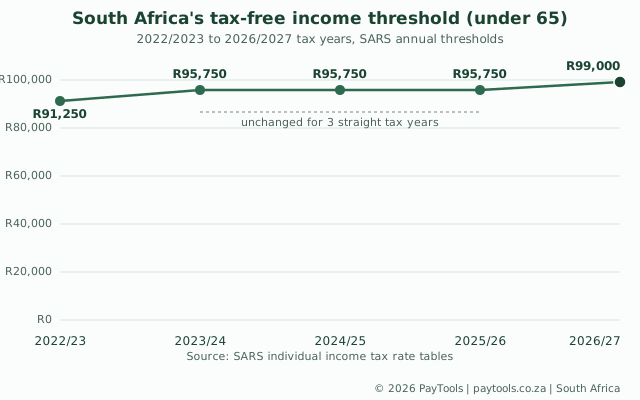
The 3-year comparison above shows 2024/2025 and 2025/2026 landing on identical numbers. Zoom out to 5 years and the same pattern shows up even more clearly: the under-65 tax-free threshold held flat at R95,750 for three straight tax years before Budget 2026 moved it.
Frequently Asked Questions
How is PAYE calculated in South Africa?
What is the tax-free threshold in South Africa for 2026/2027?
What is the difference between PAYE and income tax?
Does a retirement annuity reduce my monthly PAYE?
How much UIF do I pay per month?
What is the top marginal tax rate in South Africa?
What is the difference between gross salary and net (take-home) pay?
Do I need to submit a tax return if I only earn a salary taxed through PAYE?
Why does my PAYE look the same for 2024/2025 and 2025/2026?
What is a PAYE calculator for South Africa?
It turns your gross salary into the PAYE, UIF and take-home pay your payslip should show. Have three things ready: your gross monthly salary, your age group (the rebate changes at 65 and again at 75) and the number of people on your medical aid, plus any monthly retirement annuity contribution. The result is for the 2026/2027 tax year (1 March 2026 to 28 February 2027). If your payslip PAYE is noticeably different, check that your employer has your medical aid and retirement annuity on record.
Is this a South African income tax calculator?
Yes, for salary income: it applies SARS's 2026/2027 brackets and rebates to your employment income and returns the tax together with UIF and take-home pay. What it leaves out is income your employer never sees, such as rent, freelance work, interest above the annual exemption and capital gains. If you have any of those, your final income tax will be higher than the PAYE shown here, and SARS collects the difference when it assesses your annual return.
Is this the same as a PAYE tax calculator or SARS PAYE calculator?
Yes: PAYE tax, SARS PAYE and tax on salary all name the same calculation. The mistake to watch for when comparing results is the tax year. A March 2026 or later payslip uses the 2026/2027 tables, and a figure worked out on the 2025/2026 tables will be higher for most salaries, because Budget 2026 moved the brackets and rebates up. This page uses 2026/2027, and its comparison table shows the same salary in the two years before.
What is the best free PAYE calculator for South Africa?
PayTools' PAYE calculator is free and needs no signup. Enter your gross salary, age group, medical aid members and any retirement contribution, and it returns your monthly PAYE, UIF, take-home pay and effective tax rate, shows how much of your retirement contribution the 27.5% limit lets you deduct, and runs the same salary through three tax years. It is rebuilt every tax year against SARS's tables, currently 2026/2027.
Is there a top free PAYE calculator app for South African taxpayers?
PayTools is a website rather than an app, so there is nothing to download. Add paytools.co.za to your phone's home screen for one-tap access without using storage space or needing updates.
Where can I find official SARS tax information?
For official rates, forms and eFiling, go directly to sars.gov.za. This calculator applies the same SARS tax brackets, rebates and thresholds published there for the 2026/2027 tax year. Look for the Rates of Tax for Individuals page under Tax Rates, and check the tax year in its heading before comparing figures.